

NASDAQ: BSEM
The MedTech Innovator Has Arrived.
BioStem’s Nasdaq Uplisting Marks a Major Milestone as Its Regenerative Medicine Growth Story Enters a New Era!
BioStem Technologies (NASDAQ: BSEM) has officially leveled up, leaving the OTC markets behind and making its highly anticipated debut on the Nasdaq, marking a major milestone for the fast-growing regenerative medicine company.
The Nasdaq listing represents a major turning point for BSEM as the company enters a new chapter focused on expanding visibility, increasing market awareness, improving liquidity, and attracting a broader base of investors.
After years of building its foundation in advanced wound care and regenerative medicine, BioStem is now stepping onto a much larger financial stage and Wall Street is starting to take notice.
While the Nasdaq debut is grabbing headlines, the bigger story is what comes next….
Following seven consecutive profitable quarters before entering its current strategic transition period, BSEM recently navigated a major expansion phase after acquiring BioTissue surgical and wound care assets.
The integration temporarily impacted financial results, but the move significantly expanded the company’s commercial footprint and positioned BioStem for a larger opportunity in hospital-based regenerative medicine.
The transition period reflected investment into future growth, including acquisition integration, expanded infrastructure, manufacturing initiatives, and the costs associated with becoming a Nasdaq-listed company.
This is a company building for scale.
The acquisition of BioTissue assets dramatically accelerated BioStem’s reach into the high-value hospital and surgical markets.
Through the deal, BSEM added the established Neox® and Clarix® product portfolios, expanded its Group Purchasing Organization (GPO) relationships, and increased its direct sales force from 18 representatives to 35 in just one quarter.
The impact is already becoming visible.
Hospital revenue accounted for approximately 87% of total first-quarter revenue, highlighting the company’s strategic shift toward inpatient care, surgical applications, and higher-value regenerative medicine opportunities.
Although the acquisition temporarily affected margins due to the current manufacturing structure, BioStem expects future improvements as manufacturing technology transfers progress.
The takeaway is simple: BSEM is investing today to build a larger healthcare platform tomorrow.
BioStem enters the Nasdaq era with several major growth drivers that could reshape its trajectory:
The company has also strengthened its financial position, retiring approximately $5.3 million in combined debt principal and accrued interest obligations tied to GMA promissory notes.
BioStem finished the quarter with approximately $13.7 million in cash while maintaining full-year 2026 revenue guidance of approximately $25 million to $29 million.
The Nasdaq listing could become one of the most important catalysts in BioStem’s history.
Moving to a national exchange can open the door to greater institutional visibility, increased trading liquidity, expanded analyst coverage, and a larger investor audience.
With its Nasdaq debut now complete, BioStem Technologies is no longer simply an emerging OTC healthcare company, it is a publicly traded MedTech contender entering a new phase of growth.
As the company continues expanding hospital penetration, integrating its acquisitions, improving margins, and scaling its regenerative medicine platform, now is the time to watch closely to see whether BSEM’s Nasdaq moment becomes the beginning of something much bigger!
After Seven Consecutive Profitable Quarters, a Strategic Acquisition Transition Has Temporarily Pressured Results — But BSEM’s Expansion into Hospital-Based Wound Care, Nasdaq Uplisting, and Multi-Billion-Dollar Market Opportunity Could Be Setting the Stage for a Much Larger Growth Story!
BSEM’s latest quarterly report may have initially appeared mixed. But there’s a difference between operational weakness and strategic transformation — and BioStem’s first quarter of 2026 may look like the latter.
Following seven consecutive profitable quarters prior to this transition period, BSEM reported first-quarter 2026 revenue of $6.1 million as the company aggressively integrated the recently acquired BioTissue surgical and wound care assets.
The temporary net loss and EBITDA pressure came during what management has described as a foundational restructuring phase designed to reposition BSEM into a fully integrated, hospital-focused regenerative medicine company.
Importantly, this was not a quarter defined by collapsing demand or product failure. Instead, the results reflected acquisition integration costs, uplisting-related expenses, manufacturing transition dynamics, and the rapid expansion of commercial infrastructure following one of the most important strategic acquisitions in company history.
This distinction matters enormously!
The broader regenerative medicine landscape continues to attract enormous attention for one simple reason: demand is growing rapidly.
Advanced wound care, diabetic foot ulcers, venous leg ulcers, surgical recovery applications, and soft tissue repair collectively represent multi-billion-dollar global markets driven by aging populations, rising diabetes prevalence, and increasing healthcare utilization.
BSEM’s proprietary placental-derived allografts are specifically engineered to preserve critical tissue structure and growth factors through the company’s BioREtain® process — creating a differentiated platform designed to improve healing outcomes in difficult-to-treat wounds.
This is why many investors continue monitoring the company despite temporary quarter-to-quarter volatility.
The long-term thesis is not centered on one isolated earnings report!
It is centered on whether BSEM can evolve into a scaled regenerative medicine platform operating across both chronic and acute wound care markets while leveraging growing clinical validation and hospital adoption.
One of the reasons BioStem Technologies continues attracting attention is the bullish stance taken by Zacks Small-Cap Research, which has maintained a $25.50 price target on the stock despite recent industry turbulence and reimbursement uncertainty.
Zacks has repeatedly emphasized management’s ability to navigate operational challenges while continuing to scale the business intelligently, stating that it “continues to have a positive view on BSEM”.
The firm’s thesis has largely centered around BioStem’s historically strong execution, including its prior streak of profitable quarters, differentiated BioREtain® platform, expanding wound-care market opportunity, and growing clinical validation in diabetic foot ulcers and advanced wound healing applications.
While the company’s latest quarter reflected short-term acquisition and integration pressures tied to the BioTissue transaction, bullish analysts appear focused on the broader transformation underway — particularly the company’s hospital expansion strategy, potential Nasdaq uplisting, reimbursement catalysts, and long-term scalability within regenerative medicine.
BioStem Technologies kicked off 2026 with a defining strategic move that materially expands its growth trajectory: the acquisition of BioTissue Holdings’ surgical and wound care business. Announced January 21, 2026, the transaction marks BioStem’s formal entry into acute wound care, surgical applications, and soft-tissue repair, dramatically broadening its addressable market and accelerating its commercial scale.
Through the deal, BSEM acquired BioTissue’s Neox® and Clarix® product lines, along with a nationwide hospital-focused sales force, established Group Purchasing Organization (GPO) contracts, and infrastructure spanning inpatient and outpatient hospital settings.
The acquired assets generated approximately $29 million in revenue in 2025 and are expected to contribute positive EBITDA in 2026, immediately enhancing BioStem’s financial profile!
This acquisition does more than add revenue — it transforms BSEM into a full-spectrum wound care company, spanning both chronic and acute indications, and provides a direct on-ramp into high-value hospital-based care.
BioStem’s CEO Jason Matuszewski highlighted that acquiring these assets will give the company an “immediate foothold” in hospital-based applications while expanding its existing technology portfolio with an additional platform designed for placental and umbilical tissue allograft preservation.
“This acquired technology opens meaningful entry into high-value adjacent market segments, from acute surgical wounds to burns and soft-tissue repair, while creating synergies that enhance our entire product suite and diversify our revenue streams,” Matuszewski said.
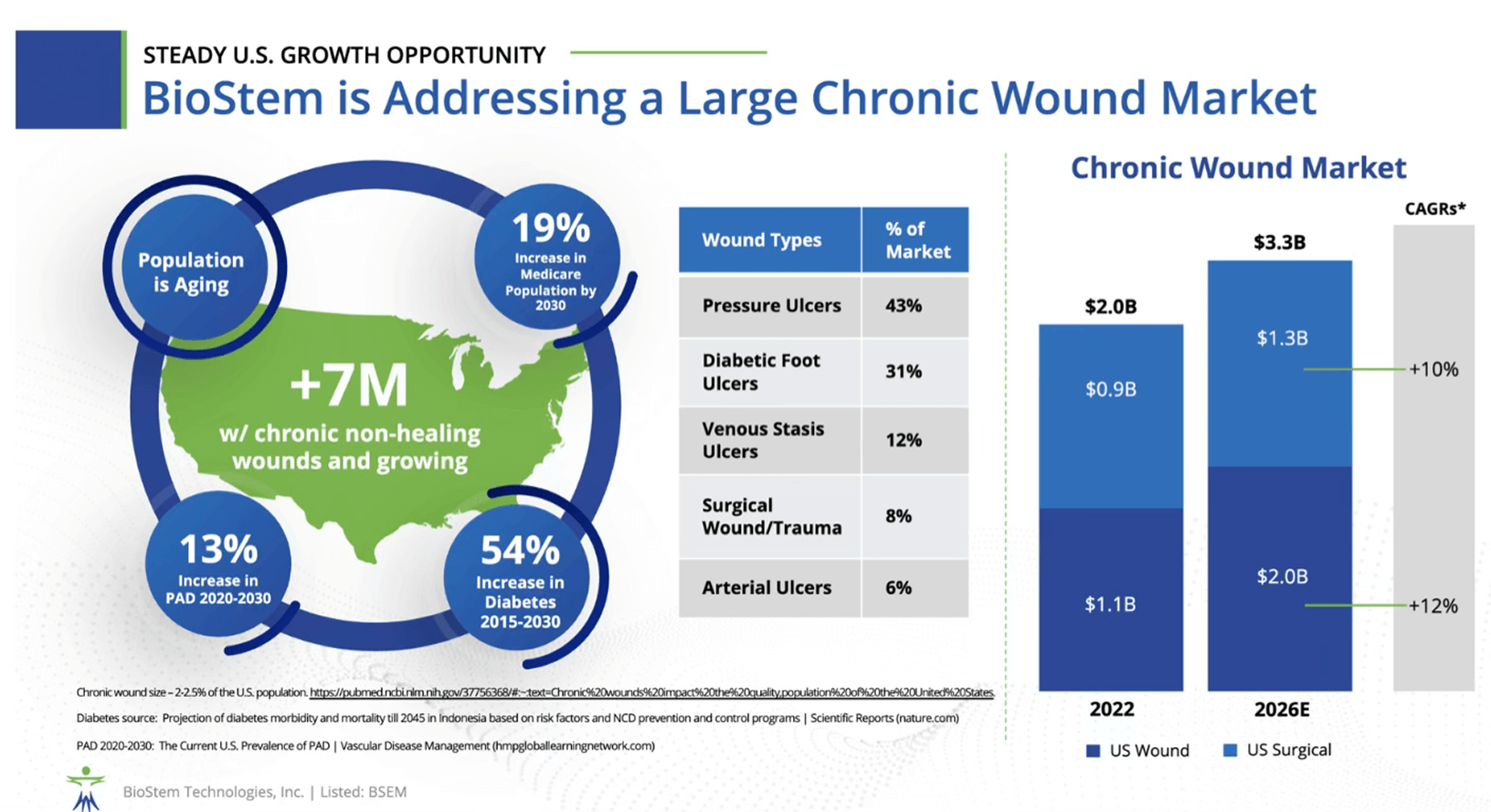
Wound care represents a rapidly advancing market. According to GlobalData analysis, the field is growing at a CAGR of 4.8% and is projected to reach a valuation over $53bn in 2034, up from $33.19bn in 2024.



As global markets move through 2026, few sectors offer the same blend of defensive resilience and innovation-driven upside as medical technology.
Aging populations, rising chronic disease prevalence, and sustained healthcare demand continue to drive spending regardless of economic cycles. Unlike traditional pharma, MedTech companies often scale faster, innovate more nimbly, and benefit directly from procedural volume and improved outcomes.
Within this environment, however, only a small subset of MedTech firms combine real profitability, peer-reviewed clinical validation, expanding reimbursement access, and operational discipline.
H.C. Wainwright & Co. has initiated coverage of BioStem Technologies (NASDAQ: BSEM) with a Buy rating and currently has a $7 price target.
The firm’s view is that the market is significantly underestimating the company’s ability to navigate the ongoing CMS reimbursement overhaul while simultaneously expanding its clinical and commercial footprint across higher-value care settings.
The bullish stance is closely tied to what the firm describes as a structural transformation in the U.S. wound care market, driven by CMS’s 2026 shift from ASP + 6% reimbursement to a flat-rate pricing model for Section 361 products. This change is expected to compress industry economics broadly, forcing consolidation and pushing companies toward more rigorous Section 351 Biologics License Application (BLA) pathways.
BSEM is viewed as one of the few players actively positioning for this transition, supported by its proprietary BioREtain platform and ongoing randomized controlled trials.
The company’s manufacturing facility is FDA-registered and accredited by the AATB (American Association of Tissue Banks).
Originally founded to leverage perinatal tissue in wound-care applications, BioStem has built a product lineup including:
AmnioWrap2™, VENDAJE®, VENDAJE AC®, VENDAJE OPTIC®,
American Amnion and American Amnion AC™
These are marketed for non-healing wounds such as diabetic foot ulcers and venous leg ulcers.
BSEM has emphasized the FDA’s recent openness to Bayesian statistical approaches in clinical research.
FDA Commissioner Dr. Martin Makary described Bayesian methods as a “leap forward” for clinical science, noting their ability to improve trial design, dose optimization, pediatric extrapolation, and integration of early-phase data into later studies.
BioStem’s CEO, Jason Matuszewski, said this validates the advanced statistical methods used in the company’s peer-reviewed study on BioRetain® allografts for diabetic foot ulcers (DFUs). Using Bayesian regression and hurdle modeling, the study went beyond simple binary outcomes to quantify probabilities of wound closure, treatment effects, and patient response across diverse populations.
The study found that BioRetain-treated wounds were nearly twice as likely to achieve complete and lasting closure compared to standard care—using rigorous FDA-defined endpoints and enrolling patients with the most difficult-to-heal wounds. Similar Bayesian methods will be applied in ongoing venous leg ulcer (VLU) and DFU studies to deepen understanding of BioRetain’s clinical benefits.
Why this matters? By embracing Bayesian approaches, BioStem can generate more precise, real-world insights into treatment effectiveness, accelerating discovery and better informing clinicians on patient care.
The market for products BSEM has developed and is continuing to develop is extensive and this cutting-edge technology can prove to be a game-changer to many patients suffering from painful and slow recoveries.
Both the diabetes wound care market and surgical recovery wound care market are growing at a tremendous rate.
Ernst & Young LLP (EY US) announced that Jason Matuszewski, CEO and Chairman of the Board of BioStem Technologies (NASDAQ: BSEM), was named an Entrepreneur Of The Year 2025 Florida Award winner!
Entrepreneur Of the Year is the preeminent competitive awards program for entrepreneurs and leaders of high-growth companies. For 40 years, EY US has celebrated ambitious entrepreneurs who are transforming industries, impacting communities and creating long-term value.
These included regenerative medicine, utilizing material derived from a human umbilical cord, that was being used to help restore tissues or organ damage because of age, disease, injury or other issues.
In 2013, Van Vurst and his father discovered South Florida-based Caribbean International Holdings, a provider of stem cell treatments.The regenerative medicine therapy proved to be a great success for Van Vurst’s father, who regained his speech, and vastly improved his motor skills and overall quality of life.
It’s no secret that the human body has an amazing ability to heal itself. You may have heard the term regenerative medicine before. It’s basically where the body uses its own systems to rebuild tissues and organs.
With its potential to heal, regenerative medicine has become a VERY hot topic and is expected to revolutionize healthcare.
The market for regenerative medicine is expected to experience significant growth over the next few years. It comes as no surprise that some of the biggest companies in healthcare are working hard to make advances in this vital space. This includes major players like Amgen, Sanofi, and Gilead Sciences.
BSEM manufactures tissue allografts that come from the human placenta. This is essentially a tissue transplant product from the placenta. In the space of skin substitutes, it is like xenografts or grafts from an animal.
An allograft is a tissue that is transplanted from one person to another. The prefix allo comes from a Greek word meaning “other.” (If tissue is moved from one place to another in your own body, it is called an autograft.)
More than 1 million allografts are transplanted each year.
BioRetain® has been developed by applying the latest research in regenerative medicine, focused on maintaining growth factors and preserving tissue structure.
The company’s portfolio of quality brands includes:
VENDAJE™, VENDAJE™ AC,VENDAJE™ OPTIC and AMNIOWRAP™.
Each BioStem Technologies placental allograft is processed at the Company's FDA-registered and AATB-accredited site in Pompano Beach, Florida.
BioStem’s proprietary BioREtain® process isn’t a commoditized graft — it’s engineered to maximize the therapeutic potency of perinatal tissue.
By preserving the tissue structure and critical growth factors, the allografts retain far more biological activity than many competing products. That means better healing, more durable outcomes, and real clinical differentiation.
The company’s brands — including:
VENDAJE, VENDAJE AC, VENDAJE OPTIC, AmnioWrap2, American Amnion, and American Amnion AC
— all leverage this patented process, giving BioStem a robust and defensible product portfolio.
The company is focused on the application of tissue engineering in wound healing and has curated a suite of versatile products called Vendaje.
Vendaje is the company’s primary product and harnesses elements of perinatal tissue and the body’s innate biology to repair and restore damaged tissue in wounds, resulting in speedier healing with reduced pain.
Vendaje comes in several different forms and sizes and is a human connective tissue matrix comprised of amniotic tissue. This amniotic tissue is processed using the company’s proprietary BioRetain process, which creates a dehydrated human amniotic membrane allograft.
Placentally-derived human amniotic membrane (AM) is a source of pro-healing growth factors and anti-inflammatory cytokines and has successfully been used in regenerative medicine for over a century.

BSEM has entered an agreement with leading US wound market solutions provider, Venture Medical, LLC., for the nationwide release of its innovative product, AmnioWrap2™.
A leading wound market solutions provider called Venture Medical, LLC., will lead the company’s commercialization of AmnioWrap2™!
AmnioWrap2 is a versatile allograft solution for wound applications. It is an advanced biologic skin substitute that is meticulously processed to offer an extensive range of wound healing and wound care solutions.
"AmnioWrap2™, is the latest addition to BioStem's product portfolio, and is developed using its proprietary BioREtain process.
This process creates an allograft derived from amniotic tissue, optimized to cater to diverse wound care applications."
The launch of AmnioWrap2 signifies a pivotal milestone as the company expands its spectrum of innovative solutions within the wound care market.
According to the company, early users of AM for wounds and post-surgical applications noted how the membrane seemed to disappear and integrate with the patient’s own tissue without a host reaction. This apparent immune neutrality is a result of mechanisms that suppress and modulate the immune system.
The increased adoption of perinatal tissues has allowed for its significant penetration into the multibillion-dollar soft tissue repair market, which is expected to reach around $8.6B by 2030!
This isn’t speculative science — BioStem’s BioREtain allograft has been evaluated in a peer-reviewed, Level 1 randomized controlled trial (RCT) for diabetic foot ulcers (DFUs), showing 53% probability of complete wound closure versus only 31% under standard of care.
That’s not just statistically significant — it’s transformational. A durable, well-documented healing effect in a notoriously hard-to-treat patient population is exactly what payors, physicians, and regulators pay attention to.
Probability of complete wound closure in diabetic foot ulcers (DFUs) — peer-reviewed, Level 1 randomized controlled trial.
For payors, physicians, and healthcare systems increasingly focused on outcomes and cost efficiency, this kind of data matters — and it directly supports BSEM reimbursement and adoption strategy.
Diabetic foot ulcers are a serious and chronic condition affecting millions of individuals within the diabetic population.
According to the American Podiatric Medical Association (APMA), a leading authority on foot and ankle health, approximately 15% of people with diabetes will develop foot ulcers.
Alarmingly, 6% of these individuals may require hospitalization due to infections or other complications related to their ulcers. The risks for diabetic patients are substantial, as DFUs are the leading cause of lower extremity amputations in the U.S. Studies indicate that between 14% and 24% of individuals with diabetes who develop foot ulcers will ultimately need an amputation.
The economic burden of these ulcers on healthcare systems is significant, with annual treatment costs estimated between $9 billion and $13 billion in the U.S. alone. As the population continues to age, this financial strain is expected to intensify, underscoring the need for more effective and accessible treatment options such as what BSEM offers.
Dr. Bert Slade, Chairman of BioStem’s Medical Advisory Board, called the results “strong evidence of treatment benefit,” reinforcing BioStem’s leadership in regenerative tissue technology.
These findings not only validate the company’s proprietary BioRetain® process but also highlight its potential to transform the $27 billion global wound care market.
The venous leg ulcer trial is progressing ahead of schedule, with top-line results expected in Q1 2026. This is just around the corner…
On the reimbursement front, BioStem already has serious momentum.
The company is navigating a shifting Centers for Medicare & Medicaid Services (CMS) landscape and is optimistic about its positioning under new reimbursement models — leveraging its strong clinical data to justify value-based adoption.
They’ve made inroads into high-value channels, including federal programs (like the VA), state Medicaid (e.g., Texas), and hospital / ambulatory surgical center (ASC) networks.
The Desert Foot Conference launch of American Amnion underscores growing adoption in specialized and institutional settings.
Chronic wounds such as diabetic foot ulcers represent a massive and growing burden, costing the U.S. healthcare system $9–$13 billion annually. BioStem has already built meaningful traction across Medicare, state Medicaid programs like Texas, the Department of Veterans Affairs, hospitals, and ambulatory surgery centers.
The addition of BioTissue’s acute and surgical wound portfolio materially expands that opportunity. With exposure to acute surgical wounds, burns, soft-tissue repair, and hospital-based care, BSEM now addresses a substantially broader market — while leveraging the same regenerative medicine foundation.
Management estimates that combined initiatives support a $300–$350 million addressable market, with further federal and state-level access expected to come online throughout 2026. Unit volumes are already reflecting momentum, with 40% year-over-year growth even amid pricing pressures!
BSEM is in the middle of a major transformation story that temporarily clouds near-term financials but potentially sets up a much larger long-term re-rating opportunity.
While Q1 2026 results reflected integration costs from the BioTissue acquisition and a reset quarter after seven consecutive profitable periods, the underlying business is shifting into a higher-value, hospital-focused regenerative medicine platform with expanding scale, stronger commercial infrastructure, and accelerating exposure to the acute care market.
With a $25.50 price target from Zacks Small-Cap Research and additional bullish coverage from H.C. Wainwright, analysts continue to highlight the disconnect between short-term accounting noise and the company’s longer-term growth trajectory across wound care, surgical applications, and regenerative therapies.
Rapid shift into hospital-based acute and surgical wound care following the BioTissue acquisition
Strong historical execution, including seven consecutive profitable quarters prior to the transition period
Expanding addressable market across chronic wounds, surgical recovery, and soft-tissue repair
Proprietary BioREtain® platform with clinical data showing significantly improved wound closure rates versus standard of care
Clear Nasdaq uplisting pathway that could unlock institutional access, liquidity, and valuation expansion
Growing reimbursement footprint across Medicare, VA, Medicaid, and hospital networks
Multi-catalyst pipeline including clinical readouts, reimbursement shifts, and potential BLA progression
Analyst-backed upside with Zacks ($25.50 target) and H.C. Wainwright ($7 price target)
At its core, the investment case is not about a single quarter — it is about whether BSEM can successfully transition from a regenerative medicine developer into a scaled, nationally recognized MedTech platform operating across both chronic and acute care settings.
In a sector defined by innovation and necessity, BioStem Technologies (NASDAQ: BSEM) is separating from the pack — and 2026 may be the year the broader market finally takes notice, especially now that the company is on the BIG BOARDS!
Disclaimer
Hugealerts.com and Tradingwire.com are owned by Sideways Frequencey LLC (“Sideways Frequency”). Press releases, research reports, company profiles and other investor relations materials, publications or presentations, including web content (investor awareness services) released by Hugealerts.com and Tradingwire.com are based on publicly available data obtained from sources we believe to be reliable but are not guaranteed as to accuracy and are not purported to be complete. As such, the information should not be construed as advice designed to meet the particular investment needs of any investor. Furthermore, some of the content contained in our publications and websites may contain forward-looking statements found in information made publicly available by the companies we highlight. This forward looking information fits within the meaning of Section 27A of the Securities Act of 1933 and Section 21E of the Securities Exchange Act of 1934 including statements regarding future possible events, expected continual growth of a company, the potential value of its securities, and look forward in time which include everything other than historical information, involve risk and uncertainties that may affect a company’s actual results of operation. We therefore strongly encourage that you visit and review any and all financial information made publicly available by highlighted companies.
Any opinions expressed in Hugealerts.com and Tradingwire.com reports, company profiles, or other investor relations materials and presentations are subject to change, are expressed and given as of the date of publication, and we disclaim any obligation to advise you of any change in any information contained herein.
The information contained herein is not intended to be used as the basis for investment decisions and should not be construed as advice intended to meet the particular investment needs of any investor. The information contained herein is not a representation or warranty and is not an offer or solicitation of an offer to buy or sell any security. To the fullest extent of the law, Hugealerts.com,Tradingwire.com and their affiliates, specialists, advisors, and partners will not be liable to any person or entity for the quality, accuracy, completeness, reliability or timeliness of the information provided, or for any direct, indirect, consequential, incidental, special or punitive damages that may arise out of the use of information provided to any person or entity (including but not limited to lost profits, loss of opportunities, trading losses and damages that may result from any inaccuracy or incompleteness of this information).
Stock market investing is inherently risky. Hugealerts.com, Tradingwire.com and their affiliates are not responsible for any gains or losses that result from the opinions expressed in press releases, on this website, in its research reports, company profiles or in other investor relations materials or presentations that it publishes electronically or in print.
We strongly encourage all investors to conduct their own research before making any investment decision. For more information on stock market investing, visit the Securities and Exchange Commission ("SEC") at www.sec.gov. and/or the Ontario Securities Commission (“OSC”) at www.osc.gov.on.ca. and/or the British Columbia Securities Commission (“BCSC”) at https://www.bcsc.bc.ca/.
Income Disclosure
Sideways Frequency has been retained by Biostem Technologies (OTC:BSEM)and has received cash compensation of $4,491,500.00to perform promotional and advertising services for a limited time. This agreement has been ongoing since September 2023 and is related to the engagement of investor awareness services for Biostem Technologies (OTC:BSEM). Sideways Frequency, Hugealerts.com, Tradingwire.com and their partners and affiliates may buy and sell shares of securities or options and warrants of the companies mentioned on this website at any time.
Sideways Frequency LLC and its affiliates may buy and sell shares of securities or options and warrants of the companies mentioned in this publication or website at any time but are not and will not at any time become affiliates or owners of more than 5% of the issued and outstanding stock of the highlighted companies.
Sideways Frequency and its beneficial owners and affiliates, including Hugealerts.com and Tradingwire.com own shares in Biostem Technologies (OTC:BSEM)
Investor awareness services and programs are designed to help small-cap companies communicate their investment characteristics. Sideways Frequency, Hugealerts.com, Tradingwire.com and their investor awareness services include the preparation of a research profile(s), multimedia marketing, and other awareness services based on the publicly available information of our clients and prepared by our partners. As such, our opinion is neither unbiased nor independent, and you should consider that when evaluating our statements regarding Biostem Technologies (OTC:BSEM).